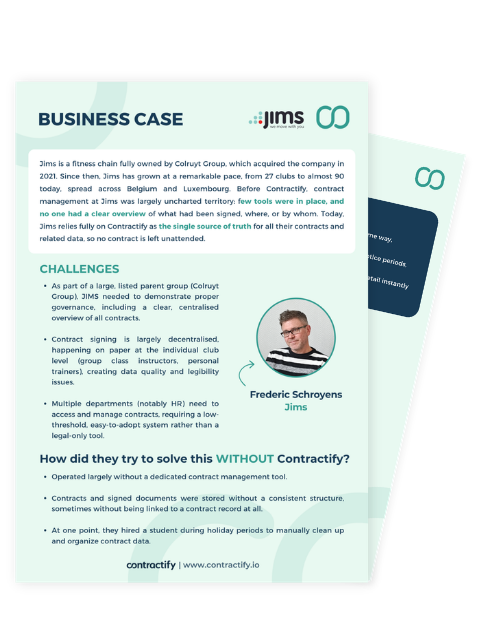
Where did the need for a contract management system come from?
When I joined Jims, it was pretty much a blank slate. Very few tools were in place, and I already knew we were planning to scale up significantly. The way Jims operated at the time simply wasn’t scalable on several fronts. A larger parent company like Colruyt expects you to run the business responsibly. and having your contracts properly stored with a clear overview is part of that. That’s when we brought in Contractify.
Why did you choose Contractify specifically?
When we went looking for a solution, the basic requirement was a system where all contracts could come together, ideally with a signing process built in, and Contractify ticked both boxes straight away. User experience has always been non-negotiable for me. If a system isn’t pleasant to use, people simply won’t use it, and adoption collapses. Contractify scored well there from day one. That mattered a lot, because several departments across Jims needed to work with it, so it had to be easy to pick up and quick to roll out.
How did the implementation go?
The software itself is easy to implement. I set it up together with Contractify’s Customer Success Manager in a fairly short time. But a system is only as good as its adoption within the organization, and that takes real effort. Departments like HR, which now manages contracts for group class instructors and personal trainers at significant scale, are genuinely happy to have one official place where everything comes together and gets signed. You do have to keep pushing adoption though. You can’t just send documents out and check back four months later. It’s a continuous process. But once that effort is made, what starts as an obligation eventually becomes a relief.
How do you experience the AI boom, and Ada specifically?
We deliberately held back on AI for a long time. As part of a larger group, you get approached by around fifteen different AI vendors almost every day, so there’s a healthy dose of caution before you adopt anything new. And honestly, within Contractify, I’m really glad it was added. The contract intake process has sped up considerably, and that delivers direct value. Fields that used to require manual entry now take just a few clicks. That’s something you can only applaud, and it’s significantly increased what I’d call the lovability of the product. You shouldn’t add AI just for the sake of it. It needs to be genuinely useful, and in this case it really is.
What's still missing today, and where do you see potential for AI in contract management?
Our biggest pain point right now is at the signing stage. Contracts with our group class instructors and personal trainers are typically signed on paper at club level, and the readability of those documents can really leave something to be desired. Sometimes you need to be a wizard just to decipher an email address. We’re hopeful Contractify can offer a solution there at some point. With any digitalization effort, I always look first at what time savings it can bring, and that’s where we still have the most to gain. We’re also exploring, together with Contractify, what might be possible on the B2B2C side. Our own clients are end consumers, and Contractify is naturally built around B2B, but we’re in conversation to see what could work there too.
What impact has Contractify had on Jims as an organization?
The biggest impact has been on continuity. If I’m out, or a colleague is, the organization doesn’t lose track of things. Contracts are easy to find, framework agreements are accessible, and the terms are clear. Before, that information was scattered across SharePoint or Google Drive, and you’d quickly lose sight of the bigger picture. We’ve made real progress there, even if there’s still more to get out of it. What I especially appreciate is seeing colleagues who were once skeptical come back and say how glad they are to have it. That happened again just last week. That never gets old.